666-year cycle
Rock Falls, Everyone DiesThe 666-year cycle is a recurring supernatural interval that turns time into both threat and punch line. Its first importance lies in the promise that a defeated demon will return after 666 years, making apparent victory temporary and framing the conflict as a cycle rather than a conclusion. As the narrative repeatedly revisits the same mountain-top battle, the number becomes a marker of recurrence, inflated ambition, and the uneasy persistence of old formulas.
First Promise: Resurrection After Defeat
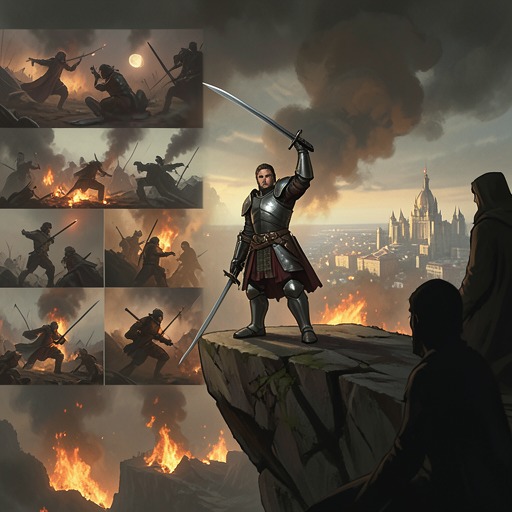
The cycle is introduced during the opening battle between a hero and a villain on a mountaintop above the clouds. After the red-skinned demon is struck down, he declares that he will resurrect in 666 years and that humanity will then be doomed. The statement gives the interval an immediate apocalyptic function: death is not final, the hero’s triumph is provisional, and the future is presented as a scheduled return of evil.
That prophecy is undercut by the circumstances of the victory. The demon is defeated not through the expected grandeur of the duel alone, but after a pebble strikes him in the face and briefly distracts him, allowing the white-clad fighter to drive a sword into his chest. The system then records that the pebble assisted in defeating Demon Lord Diablos, awarding 500,000 assist experience and the title Enemy of Demons. The 666-year threat therefore enters the story beside an absurdly immediate game-like reward, placing cosmic prophecy and numerical progression in the same frame.
Repeated Battle and Repeated Threat
The number returns when the narrative stages another version of the mountain-top confrontation in Chapter 10, A Quarry to Settle. There, the Demon Lord kills the Hero after a dragon’s storm wind knocks the human off balance, then announces that his reign will last for 666 years and condemn humanity to servitude. The interval has shifted from a resurrection promise to a projected reign, but its narrative work remains similar: 666 years converts villainy into a long-duration historical order.
The repetition is significant because the scene itself is not allowed to stand as a definitive ending. The dragon’s passage interrupts the duel, the Hero’s death follows from a momentary displacement, and the narration dismisses the combatants as an irrelevant sideshow. The cycle thus exposes the instability of conventional final battles. A declaration of centuries-long rule can be made with absolute confidence, yet the story’s larger machinery can simply move past it, leaving the supposed central apocalypse subordinate to the movements of a rock, a dragon, and the system that measures them.
From Prophecy to Accumulation
The later appearance of 666 transforms the interval from a forecast of political domination into a unit of absurd supernatural accumulation. In the epilogue titled Sisyphus, the villain claims to have used the same teabag to make 666 cups of tea, thereby gaining the power of Infinite Tea and becoming the Infini-tea Demon. The number no longer measures years separating defeat from resurrection or the duration of a reign. It measures repetition performed until repetition itself becomes power.
This variation preserves the cycle’s original logic while parodying it. Earlier, 666 years promised that evil would return after a long wait. Later, 666 repeated acts of preparation produce a new form of evil in the present. Time has been compressed into ritual accumulation: instead of waiting centuries for the demon’s power to reappear, the villain manufactures power by repeating an action hundreds of times. The result is an escalation from apocalyptic prophecy to comic procedural excess, while the number’s association with demonic danger remains intact.
Cycles Within the Larger Structure
The 666-year cycle belongs to a broader architecture of recurrence. The book repeatedly begins with the formula of a hero and villain facing one another on a high mountaintop: it appears in the opening chapter, returns in Chapter 10, reappears at the beginning of The World Ends With Rock, and is staged once more in the Sisyphus epilogue before the battle has even started. Each return resembles a ritual repetition, but each is disrupted by a different force or tonal shift.
This pattern places the 666-year interval between ordinary chronology and mythic recurrence. The number promises a future measured by centuries, while the repeated opening collapses distinctions between first battle, remake, ending, and epilogue. At the same time, the rock’s own progression is tracked through immediate system notifications: it assists in defeating Demon Lord Diablos, repeatedly levels up, reaches level 9 after achieving 1,000 out of 1,000 experience, and eventually encounters an integer overflow during a massive experience calculation. Against that accelerated numerical time, 666 years appears almost impossibly slow; against the book’s geologic and planetary scale, it is merely another recurrence marker.
The cycle also resonates with the movement from destruction toward creation. The narrative reaches The World Ends With Rock, then proceeds to Genesis, where the rock sits at the center of a planet beneath the earth and waits for a quest prompt that has taken a long time to appear. The epilogues then return to the day the world ended and to another not-yet-begun mountain-top confrontation. Within this structure, 666 years does not produce a single linear future. It helps establish a world in which endings reopen into beginnings, prophetic threats become repeated scenes, and the same ritual language can survive even after the world itself has changed.